Objective & Overview
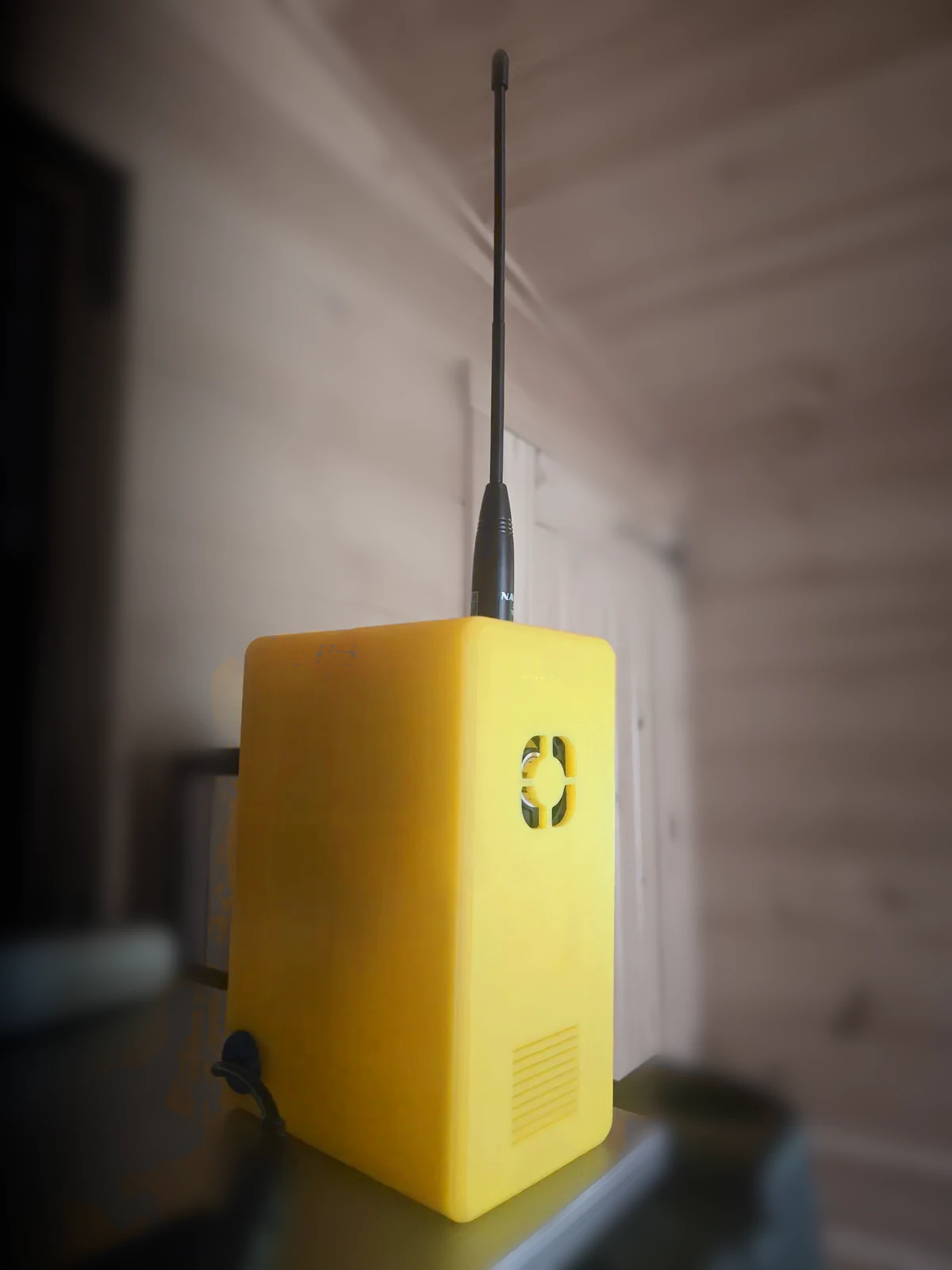
A dedicated, self-contained AllStarLink simplex micro-node built around a Raspberry Pi 3 Model B+ and a SHARI (SA818-based) USB RF module. The goal is to maintain reliable, 24/7 access into local and nationwide AllStar hubs and repeaters using a low-power handheld radio around the house and property.
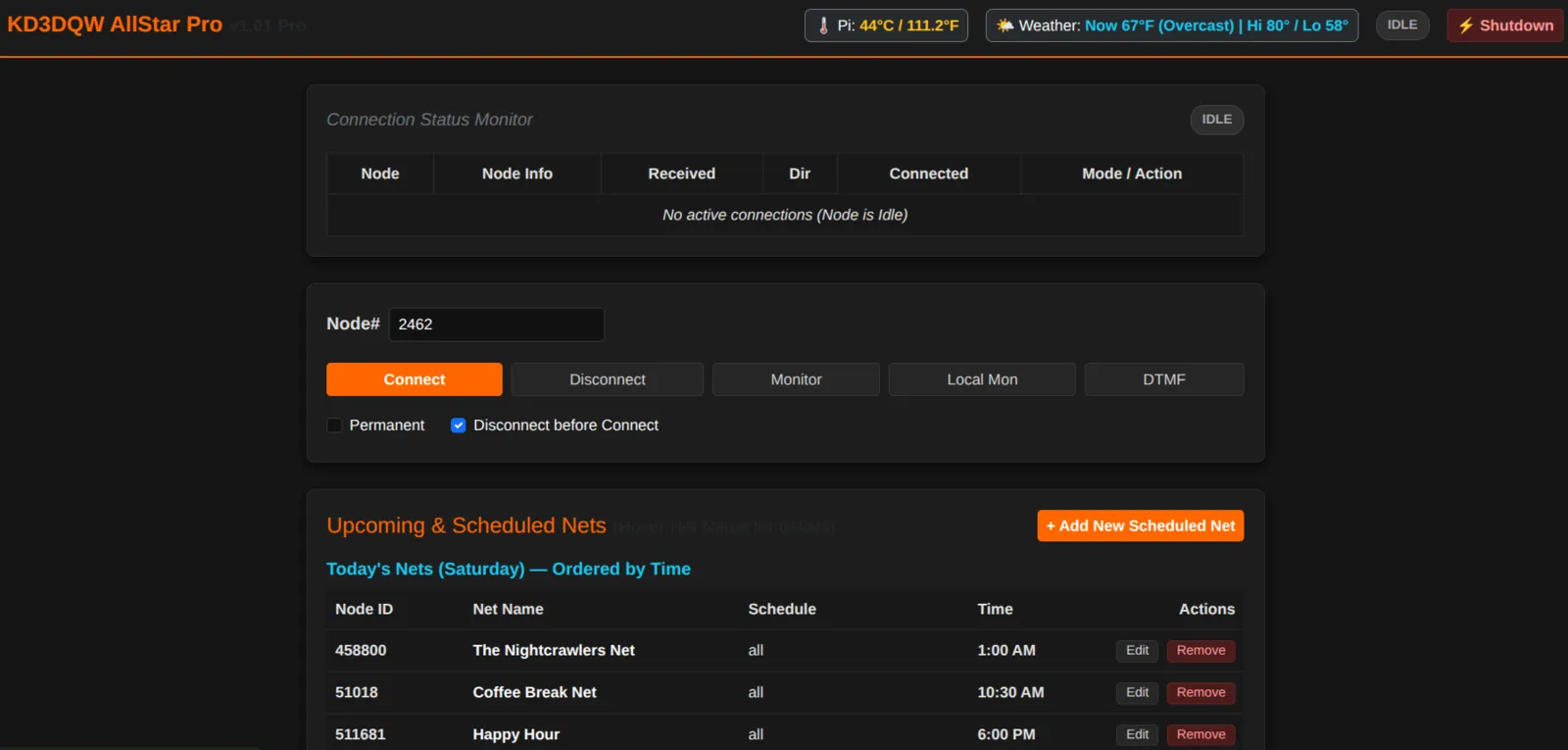
The build is housed in a custom 3D printed dual enclosure with an integrated 5V cooling fan to manage thermals during sustained transmissions. It runs standard AllStarLink (ASL), Allmon for node administration, and a custom monitoring dashboard.
Items & Components Used
| Item / Component | Model & Specs | Role / Configuration |
|---|---|---|
| SBC Controller | Raspberry Pi 3 Model B+ | Quad-core 1.4GHz, 1GB RAM, running ASL |
| RF Interface | SHARI USB AllStar Node | SA818 UHF transceiver module + CM108 USB audio |
| Active Cooling | 5V DC Brushless Fan | Powered via GPIO Header (Pin 4: 5V, Pin 6: GND) |
| Enclosure | Custom 3D Printed Housing | Holds original Pi case + SHARI metal RF shielding intact |
| Storage | SanDisk 32GB High Endurance microSD | OS, ASL configs, logs, and web dashboard |
| Software Stack | ASL + Allmon + Custom Web Dash | Node provisioning, audio calibration, and telemetry |
Visuals
Build Log & Engineering Notes
Pi Appliance Setup & Software Provisioning
Started by following the community guide for the AllStarLink Pi-Appliance Setup.
Flashed the ASL image onto the microSD card, registered the node on the network, set up rpt.conf and simpleusb.conf, and calibrated the SHARI's CM108 soundcard levels via simpleusb-tune-menu for balanced transmit and receive audio.
Dual-Housing Integration & 5V Fan Cooling
Modeled a custom 3D printed enclosure designed to dock both devices together without disassembling either unit. Rather than stripping the Pi out of its case or removing the SHARI from its original enclosure, both were kept intact to preserve the metal casing's critical RF shielding against local receiver desense and stray harmonics.
Integrated an active 5V cooling fan to circulate air across both housings and keep the SA818 module and Pi CPU cool during sustained net operations. (A revised Rev 2 enclosure design is currently planned.)
AC Wall Wart Switching Hum & Ground Loops
Current Status: The node operates completely clean and hum-free when powered from a DC battery bank. However, powering via AC wall adapters introduces a low-frequency hum/whine onto the transmitted audio.
Troubleshooting Attempted: Swapped multiple switching power supplies, added snap-on ferrite chokes on DC and USB cables, and tested different AC circuits. The noise persists across standard adapters, indicating switching ripple coupling into the CM108 audio ground plane.
Voltage Sag Analysis & Linear Regulation
- Probe the 5V rail with a multimeter and scope under full RF transmit load to check for voltage drop and ripple amplitude.
- Test an isolated DC-DC converter or low-dropout (LDO) linear power supply to filter out AC switching noise.
- Finalize the Rev 2 3D enclosure CAD model once clean AC power delivery is resolved.